



tel: Kościół Łącko
+4818 444 60 29

e-mail Kosciół Łącko
lacko_par@diecezja.tarnow.pl

Archidiecezja
+48 234 523 235
Last update 2026-05-16
-2025-09-16-09-47-54.webp)
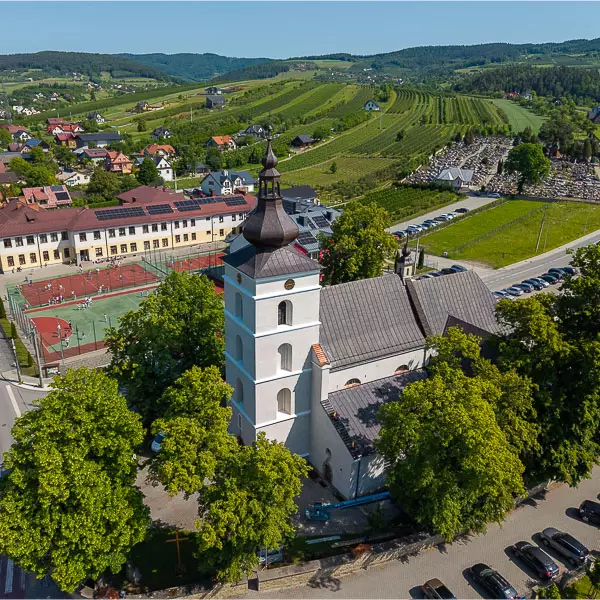
The parish church of St. John the Baptist in Łącko is one of the region’s most valuable temples, combining the heritage of many eras. From Romanesque sculpture, through Gothic and Baroque, to the contemporary cult of Blessed Celestyna – every part of this place tells its own story.
The parish of Łącko dates back to at least the 13th century. The first wooden church was built around 1220 and served the villagers for nearly three centuries. Around 1550, due to frequent floods, it was moved to higher ground. There it was gradually expanded – with a tower and arcades – until it burned down at the beginning of the 18th century. In 1720, a new brick church was consecrated, dedicated to St. Michael the Archangel and St. John the Baptist.
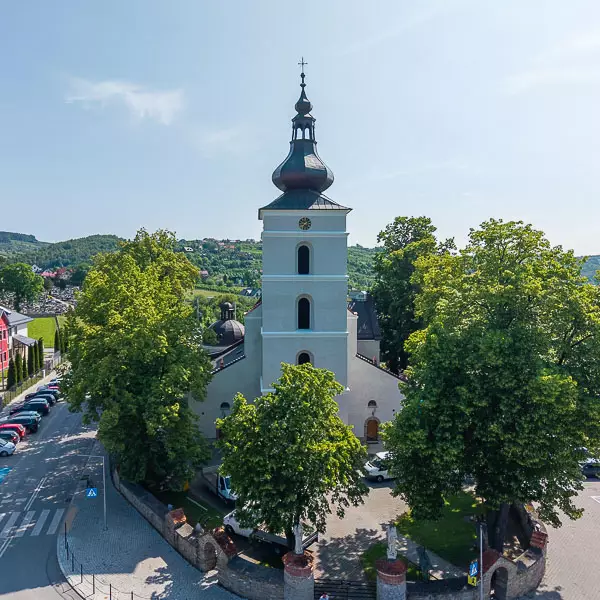
The current church in Łącko is a three-aisle basilica with a two-part presbytery and side chapels. From the west, it is dominated by a massive square tower topped with a neo-Baroque onion dome and lantern. The roofs vary: gabled over the nave and presbytery, single-pitched over the aisles, and crowned with a domed northern chapel. The façades are simple and bright, articulated with pilasters and 18th-century portals.
Particularly notable is the Chapel of Our Lady of Częstochowa, whose dome references the Sigismund Chapel on Wawel Hill – a rare example of royal inspiration in a rural Małopolska church.
The church holds priceless relics of the Middle Ages. The most valuable is the wooden, polychrome sculpture “Head of St. John the Baptist on a Platter” from around 1250 – one of the oldest Romanesque carvings in Poland. The original is kept at the Diocesan Museum in Tarnów; a faithful copy remains in the church.
Another treasure is the wings of a Gothic triptych from around 1440, discovered in a side altar. The paintings depict the Beheading of St. John the Baptist, the Coronation of Mary, and saints – patrons of the poor, prisoners, and dying. Despite later repainting, they are a vital testimony to the parish’s medieval past.
The main altar, an early Baroque work from 1621 by Kraków sculptor Balthasar Kunz, dominates the interior. Statues of apostles and saints flank the central image of Our Lady of Mount Carmel.
The church also features a Gothic baptismal font from 1493, numerous Baroque side altars, Mannerist paintings, and a late-Baroque organ. Wall paintings enrich the interior – some from the 1950s (by Prof. Franciszek Walczowski), others from 1996 by Prof. Jerzy Lubański.
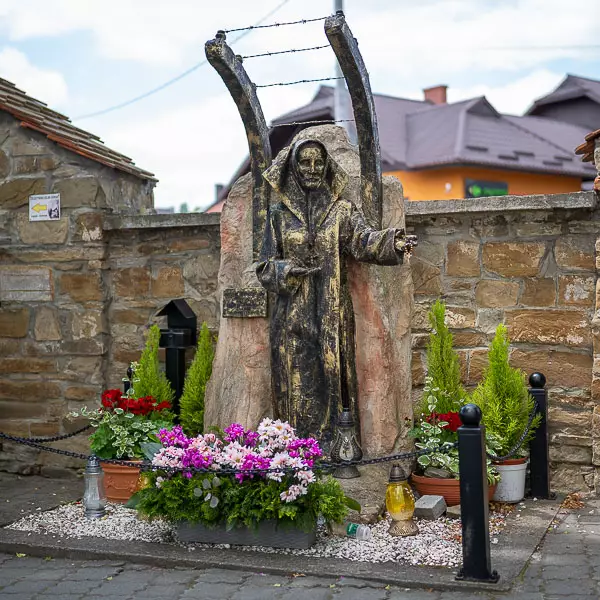
A special place is the altar of Blessed Celestyna Faron in the right side nave. This 17th-century altar, once home to a painting of the Immaculate Conception, now holds an image of Celestyna – a nun baptized here and beatified by Pope John Paul II. In its base lies a reliquary with a rosary bead and soil from Auschwitz, where she died a martyr’s death.
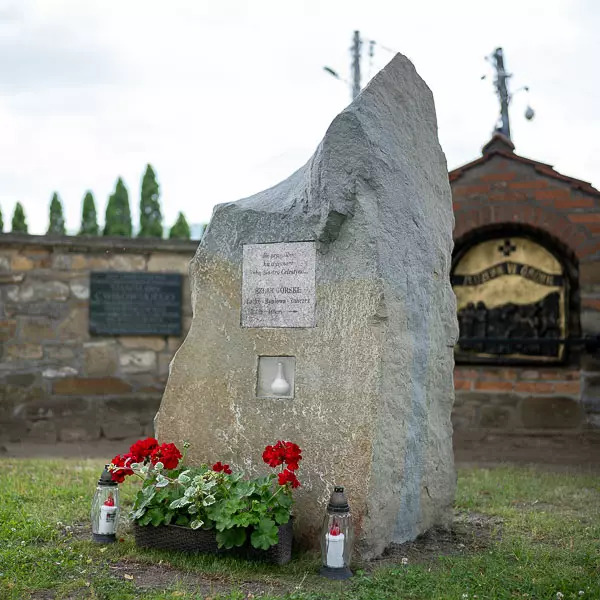
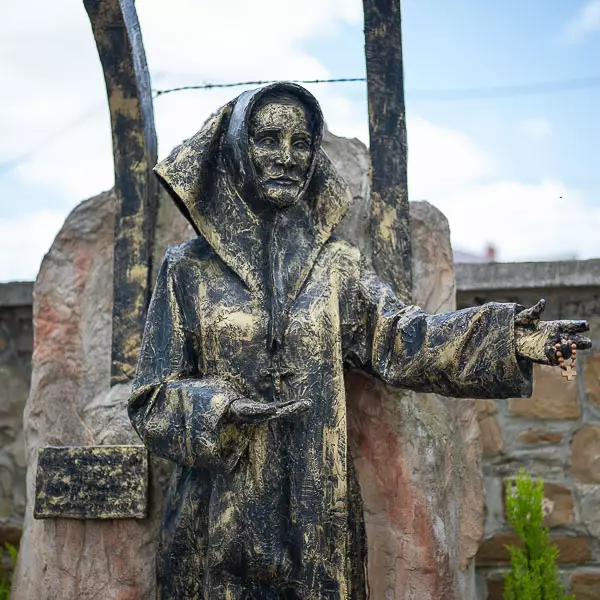
Her memory is still vivid: in 2019 her statue was erected in front of the church, and in 2025 a new painting dedicated to her was consecrated, linking the ancient church with the modern story of faith and sacrifice.
The church in Łącko unites centuries of art and faith: from Romanesque sculpture to Gothic triptychs, Baroque altars, and the modern cult of Blessed Celestyna. It is both a house of prayer and a landmark of culture and heritage in the region.